How to choose a foosball table: what actually matters

Updated: 4 days ago
Foosball tables all look similar in a photograph and play nothing alike. Six things decide whether a table is still enjoyable in five years, and only two of them are visible from across the room.

1. Playfield thickness - the single best indicator
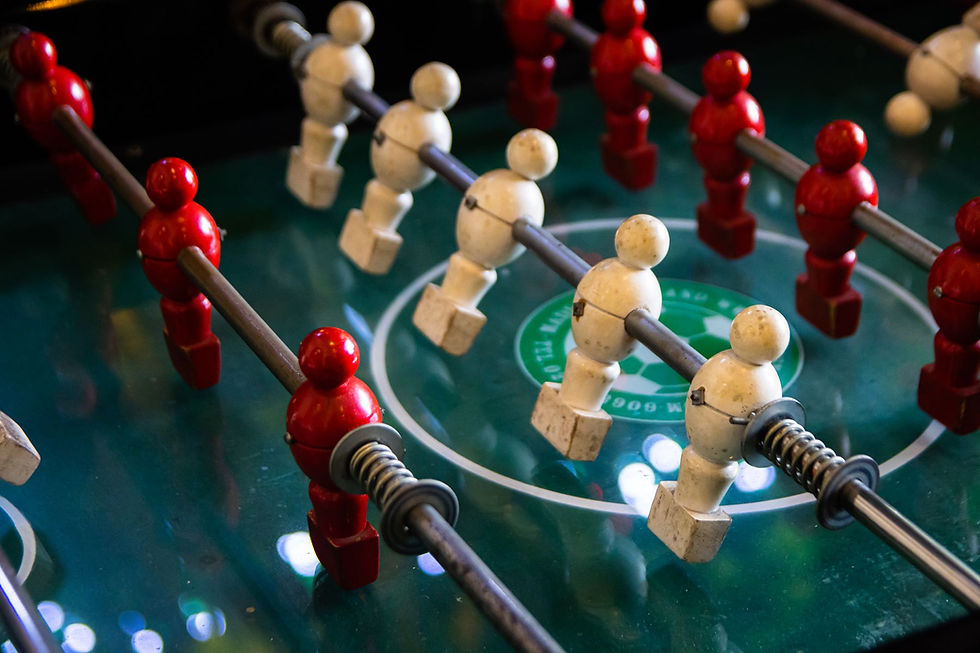
The playing surface is a board. A thin board flexes and rattles under a hard shot; a thick one absorbs it and stays quiet and predictable. Thickness is also the honest proxy for how the rest of the table is built - nobody puts a 2cm field on a flimsy cabinet.
1cm - entry level. Fine for occasional family games.
1.5-1.8cm - the practical sweet spot for a home or office that will actually use it.
2cm - built for sustained, competitive play.
Across our range this is exactly what separates the 04 at AED 1,400 and the 101C at AED 1,600 (1cm) from the A03 at AED 1,900 and the X10 at AED 4,000 (2cm).
2. The surface on top of the board
Melamine - the standard. Smooth, consistent, good value.
HPL (high-pressure laminate) - much harder wearing. Worth it anywhere the table gets used daily. Our coin-operated 113B and 170 both use 1.7cm MDF with HPL on both sides.
Tempered glass - protects the field completely, cuts noise, and cannot be scratched by a ball. The X1/X3 uses a tempered glass field; the 113B and 170 add a 0.5cm tempered glass top over the playfield.
Glass is the choice worth understanding: it changes the ball's behaviour slightly and it makes the table quieter, which matters more than people expect in an office.
3. Rods

This is the part your hands are on the whole game.
Hollow steel rods are lighter, so they move faster and are less tiring in long sessions. Preferred by most competitive players.
Solid steel rods are heavier and feel more substantial. More durable under rough use.
Bearings matter as much as the rod. Nylon bushings are the norm; proper bar bearings are noticeably smoother and quieter over a long game. The A07 at AED 3,500 has bar bearings and it is the difference you feel first.
Telescopic rods do not pass through to the far side of the cabinet. That means nothing sticking out to walk into, which is the right answer for a home with children or an office corridor. The X1/X3 uses telescopic bars.
4. Cabinet and weight
A light table walks across the floor during a fast game. Look for a reinforced cabinet, a middle bracing bar between the legs, and honest weight. Corner protectors and stainless rail ends are a good sign - they show the maker expected the table to be knocked about.
5. Goalie configuration
Three-goalie is the classic setup and the one most people grew up with - easier to defend, more forgiving, better for mixed-ability groups. One-goalie is the competition standard and rewards better defensive technique. The A03 uses the three-goalie configuration.
Neither is better. Buy the one your players expect.
6. Indoor or outdoor
An indoor foosball table on a Dubai terrace will not survive a summer. The cabinet swells, the field delaminates and the rods corrode.
If the table lives outside, it needs to be built for it: a weather-resistant cabinet and a field that does not care about moisture. Our Outdoor 019A/B at AED 6,000 uses an 8mm frosted tempered glass field on a weather-resistant structure, for villas, gardens, terraces, schools and hotels.
If it is going in an office

Offices have three requirements a home does not:
Noise. A glass-topped field, good bearings and intact bumpers make a table dramatically quieter. It matters when someone is on a call fifteen metres away.
Safety. Telescopic rods, so nothing protrudes into a walkway.
Durability without supervision. Office tables get played by everyone and maintained by nobody. Buy the 2cm field and the reinforced cabinet.
The X10 at AED 4,000 is our usual office recommendation - a 2cm field and commercial-grade construction in a compact 137.2 x 76 x 89cm frame. Where the table is a statement piece in a reception or lounge, the X23 at AED 8,000 with its clear acrylic body is the one people photograph.
Space you need
Every table in our range has the standard 68 x 117cm playing field, in an overall footprint of roughly 137-144cm long by 72-76cm wide. Leave about a metre clear at each end for players, and allow for the rods sliding out on through-rod tables - typically another 30-40cm each side. In practice a foosball table wants a space around 3.4 x 2.4 metres to be comfortable.
Coin mechanisms
If the table is going into an arcade, café, club or recreation centre, a coin mechanism turns it from an amenity into revenue. The 113B at AED 3,200, the 170 at AED 4,000 and the DFG at AED 2,900 are all coin-operated.
Our range, by budget
AED 1,400 - 1,700: 04, 101C, 101M. Entry-level fields, solid steel bars, compact footprints. Good family tables.
AED 1,900 - 2,900: A03 (2cm, three-goalie), X1/X3 (tempered glass, telescopic bars), 186 (1.8cm melamine, wooden legs), DFG (2cm, coin-op, rubber edges). The value band.
AED 3,200 - 4,000: 113B, A07 (bar bearings), 129A (2cm), 170, X10. Commercial builds and serious home tables.
AED 6,000 - 8,000: Outdoor 019A/B, X23. Specialist and statement tables.
A foosball table is repairable - use that
Unlike most game tables, a foosball table is genuinely serviceable. Worn parts are cheap and replacing them makes an old table feel new:
Rod bearings - AED 20
Bumpers, 16 pack - AED 60
Hollow steel rod - AED 65, or solid steel - AED 75
Handles, 8 pack - AED 120
End caps and nylon washers - AED 5
If a table plays badly, replace the bearings and bumpers before you replace the table. It is usually the whole problem.
Come and play
All of these are set up in our Dubai showroom. Call or WhatsApp 055 918 4887, or see the full foosball range.


Comments